Time and
the Vedic Scriptures
What does the word religion mean? The Oxford
dictionary tells us that it
is the belief in and worship of a superhuman controlling power, esp. a
personal God or gods. It concerns a set of beliefs, values, and
practices based on the teachings of a certain spiritual leader or
Lordship. In the broadest sense it pertains to a cause, principle, or
activity pursued with zeal or conscientious devotion. Lastly it is a
life or condition of a person in a religious order.
We know from the vedic scriptures the superhuman controlling
power as mentioned in the dictionary to be the Time (see time-quotes). The Lord or Godhead is, operating from the beyond or
right in front of us, just the messenger of or chastiser for the sake
of the morality of keeping the soul properly associated with Time. In
respect with the Time of the Lord is one of God and thus is respect for
His time not just an impersonal but also a personal matter. In other
words: if we are proper with the impersonal of Time, we will
automatically be personally correct by the grace of His identification
with that time (thus capitalized as Time). We in our religions worship
the Lord who gave His life to be the order of time of regular worship
that carries His grace. Other types of time respect do not carry His
grace according the purâna. The book states that
deceitful religiosity, viz. religiousness with an ulterior motive, or
an order of time that is motivated and manipulated for the money, is
rejected as being offensive to the divine interest (S.B. 1.1.2). The vedic scripture the Bhagavad Gîtâ - veda
means knowledge, thus the scripture of Knowledge -, explicitly states
that such worship of 'other gods' - read: forms of time-respect - is,
even though confirmed as a form of devotion, simply wrong (B.G. 9.23).
The
respect
of Time must be according His nature, in fact your own
nature shared with Him or your and His dharma, or else one runs
into danger being alienated from His will or creation (B.G. 3.35).
From
this
we may conclude that the effort to control the time, outside
of His will, outside of the nature of our own planet and position in
the sky, is a fundamental source of discord between not only the
religions but all associations of man, political, sportive or
otherwise, that thus conceived, are to be considered deceitful and of a
false ego. From this notion does half the world - scripturally correct
though - reject all religion while the other half of mankind by the
latter again is rejected for its other types of association being
profane and possibly heretical or materialistic. Thus seen would all
human association be wrong in a democratic hell of indecision. The
Gîtâ (18.66)
on
top
of that confirms this negative attitude in saying: 'abandon all
forms of religion (and other association) and surrender to Me only'.
Any human accord of time not in tune with His nature is thus,
fundamentally seen, nothing but an obstruction as a selfish arbitrary
paradigm relative of value that, confounding, can be exchanged for
another, and any religion about that power of conditioning is thus
factually wrong vedically speaking. Only He and what is His, the divine
ordinance and the person thereof, is, vedically to be considered
correct. Since He identifies with the natural manifestation of time
(see again time-quotes) is thus the true of religion in the end a scientific
affair, since with Him one is scientifically bona fide or of a valid
respect for the impersonal order of His Time. He is also thus the
Godhead or original scientist of the scientists. Or put in simple civil
language: don't mess with the time of nature or you're in illusion.
Thus is the thesis held by some that science and religion are
incommensurable refuted. Science tells the numbers free from illusion
and religion, faithful to the vedic command, tells what to do with it
once you get them right, viz. once you are valid or free from illusion
in the more personal reckoning.
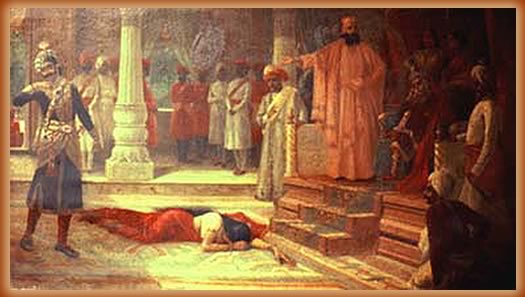
'Draupadî
humiliated' -Modern time humuliates mother nature. - by R.R. Varma
When Pope Leo XIII, in Immortale Dei, 1885, said that
"The equal toleration of all religions ... is the same thing as
atheism", he in fact said that religion or theism is the intolerance of
other respects of time, and that is confirmed by the vedic view. The
problem though is that most religions nowadays have fallen in their
factually abiding by human and not by divine or scripturally defined
concepts of time in knowing the politically set standard time and the
commercially set linear weeks. So, not to throw away the child with the
bathing water, must the religions of the world all learn to follow to
the original, scripturally defined, order of Time and, thus purifying,
restore their stature as personalistic sciences in stead of being
political philosophies of deceit and fraud that, messing with numbers,
end up in materialistic impersonalism and voidism. We can't have
religions that in a political, unholy defense of their own order of
time, go against civil rights that defend the freedom of association
and religion. That fundamentalist option is unwanted democratically.
The exclusivist egotistical options of the politicized religions must
be treated to their own practice: with denial as for their offenses
with the Time. All religions will have to purify their time-respect to
be able to coexist peacefully and to continue existing on themselves:
Islam mustn't follow standard time and timezones, Christianity must not
act contrary in doing it on earth different as it is in the sky or 'heaven'
and
Hindus
can't afford to manage the state with clocks and calendars
that deviate from the light of the sun and the moon that would be their
Lord in the Bhagavad Gîtâ. That conceit with ulterior
motives must be over. Standardtime is something for railroads, the
telephone company and broadcasting companies. It is pragmatical and
economical. Religiously though it must be condemned. Let the religion
be the example that is to the principle and scientific at the original
time and let politics and trade be the watering down of that wine with
standard-time manipulations that are known to be dangerous and
alienating from the personal relevance vedically speaking.
From etymology is, according to Cicero, the word religion
derived from relegare, re- "again" and legere
"to read" and thus the word would mean "go through again, read again,".
Therefore is it essential to any religion to re-read its scriptures and
so do we, following this introduction, introduce the scriptures
humanity started with: the most basic vedic ones. One evidently forgets
the time of nature and God (in repression of the 'Father') as one
working for ulterior purposes corrupts in degraded forms of culture and
thus must that truth be remembered. Also does the word in popular
etymology mean 'to reconnect' or 'to restore the bond'. It is necessary
in association with other devotees to return to the Book of Books in
order to celebrate its truth and thus restore and reconnect to its
divinity. Considering the above mentioned that can never happen with
standard time without becoming an hypocrite and cheater doing damage to
the credibility and livability of the religious claim in fostering
sectarianism and fundamentalist exclusivism. In fact is all religion
abiding by standard time, as said, wrong according the Gîtâ
and must it, that time-practice, be abandoned. This is the vedic
purport: strictly speaking is Judaism, unless the Messiah is
respected, no religion at all, but only a historical form of attachment
to a speculative and inconsistent notion of God, since it is not clear
who the ultimate religious leader is or what the spiritual kernel of
purity is, and thus what the integrity and authority of the approach
would be (should we kill for a 'promised land' or 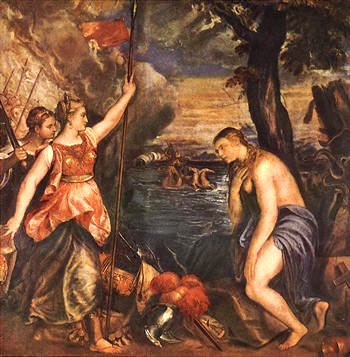 shouldn't we
kill at all?) . With Jesus then as the Messiah, the King of
Heaven, we have reached integrity with the jewish claim of God but have
we not found the exact meaning of what Christ called doing it on earth
as it is in heaven, all too materialistic being indifferent about God's
order of time. Islam corrected that passionately condemning the Jews
while propounding the times for prayer and fasting, but couldn't
determine the right time themselves for the religious gatherings in the
mosque in positioning the culture in linear weeks from the beginning
and, even lower, managing their affairs by standard time nowadays, so
that their linear Fridays and times of work are not of Allah in fact,
nor being pure to the moon nor to the sun as Mohammed demanded. Thus
fallen with passionate Islam disobedient to itself and their sometimes
outright and warmongering, projective hatred against the jewish error
and the christian shortcoming of not finding the father of Time by them
called Allah, had we, after the fall of catholic Rome that abolished
its own monasterial order of time in 1582 (the julian order that was
only wrong in leaping), the philosophy of a rationalist and empiricist
enlightenment. That philosophy, though scientifically successful,
itself came to a bloody fall in the ulterior motives of a political
opposition going for worldly gain with debilitating wars of horrid
regimes worldwide in the centuries following. With the enlightenment of
western science the religion was in correct reform indeed abandoned,
but the Lord of the natural sciences wasn't found, and thus turned
democracy out to be a failure of quantitative fixations running into
the dictatures that fought for supremacy in a hell of modern time
disarray with the natural sun and moon. Modern time proved a difficult
time indeed and so it, beginning the 21th century, still is. The modern
sense of the word religion as "recognition of, obedience to, and
worship of a higher, unseen power" that was from 1535, turned after the
gregorian time-reform into a mechanized religion in the sense of
"scrupulous and exact" as recorded from 1599 (see etymological dictionary).
shouldn't we
kill at all?) . With Jesus then as the Messiah, the King of
Heaven, we have reached integrity with the jewish claim of God but have
we not found the exact meaning of what Christ called doing it on earth
as it is in heaven, all too materialistic being indifferent about God's
order of time. Islam corrected that passionately condemning the Jews
while propounding the times for prayer and fasting, but couldn't
determine the right time themselves for the religious gatherings in the
mosque in positioning the culture in linear weeks from the beginning
and, even lower, managing their affairs by standard time nowadays, so
that their linear Fridays and times of work are not of Allah in fact,
nor being pure to the moon nor to the sun as Mohammed demanded. Thus
fallen with passionate Islam disobedient to itself and their sometimes
outright and warmongering, projective hatred against the jewish error
and the christian shortcoming of not finding the father of Time by them
called Allah, had we, after the fall of catholic Rome that abolished
its own monasterial order of time in 1582 (the julian order that was
only wrong in leaping), the philosophy of a rationalist and empiricist
enlightenment. That philosophy, though scientifically successful,
itself came to a bloody fall in the ulterior motives of a political
opposition going for worldly gain with debilitating wars of horrid
regimes worldwide in the centuries following. With the enlightenment of
western science the religion was in correct reform indeed abandoned,
but the Lord of the natural sciences wasn't found, and thus turned
democracy out to be a failure of quantitative fixations running into
the dictatures that fought for supremacy in a hell of modern time
disarray with the natural sun and moon. Modern time proved a difficult
time indeed and so it, beginning the 21th century, still is. The modern
sense of the word religion as "recognition of, obedience to, and
worship of a higher, unseen power" that was from 1535, turned after the
gregorian time-reform into a mechanized religion in the sense of
"scrupulous and exact" as recorded from 1599 (see etymological dictionary).
Thus is religion in popular etymology among the later
classical and many other modern writers connected with religare in the
sense of "to bind fast" as a notion of "placing an obligation on," or
"bond between humans and gods". And that bond was originally described
by Einstein (1879-1955) in Science, Philosophy and Religion
(1941) as necessary in his saying: 'Science without religion is lame,
religion without science is blind'. But having turned into politics as
in the to Bertrand Russell 1872-1970 attributed saying that: 'Religion
may in most of its forms be defined as the belief that the gods are on
the side of the government', must the concept of religion be drawn out
of the political sphere and be restored to its authentic purity and
stature of being religious in respecting the natural local environment,
people included. And that must be done by means of the exclusive but
broadminded vedic wisdom that critically defends the personal
selfrealization of enlightenment and liberation in service of and
association with God and the Time, as it should have been, and as it by
all of us, world citizens, always has been envisioned. After all does
the dutch word for religion 'godsdienst' simply mean being of
service to God and not, also commemorating this writer, to a guy or
system in between, and that is that. Only then do we have an order that
can be called truly religious.
The vedic classics:

 For the sake of clarity and
loyalty the present popular versions of the Bhagavad Gîtâ
(counting five on the Internet when the translator began) have been
studied. There has been concluded to a concatenated, readable version
of filognosy: The Bhagavad
Gîtâ of Order (also read out in Audio): a translation as close
to the original Sanskrit as possible with no literary pretenses. The
book, constituting a serious work of personalist philosophy, is the
sermon of Lord Krishna on the battlefield of Kuruksetra just before the
great war of the Mahabharat. Its title means the song of the Lord. It
describes the ins and outs of three basic kinds of yoga: the yoga of
work, the yoga of devotion and the yoga of spiritual knowledge. It
offers word-for-word-translations, the preceding translation and links
to the other versions on the internet and the Sanskrit dictionary, so
that each can retrace this translation back to its original source.
For the sake of clarity and
loyalty the present popular versions of the Bhagavad Gîtâ
(counting five on the Internet when the translator began) have been
studied. There has been concluded to a concatenated, readable version
of filognosy: The Bhagavad
Gîtâ of Order (also read out in Audio): a translation as close
to the original Sanskrit as possible with no literary pretenses. The
book, constituting a serious work of personalist philosophy, is the
sermon of Lord Krishna on the battlefield of Kuruksetra just before the
great war of the Mahabharat. Its title means the song of the Lord. It
describes the ins and outs of three basic kinds of yoga: the yoga of
work, the yoga of devotion and the yoga of spiritual knowledge. It
offers word-for-word-translations, the preceding translation and links
to the other versions on the internet and the Sanskrit dictionary, so
that each can retrace this translation back to its original source.

 A
Song
of
Fortune - A modern Gîtâ: Gnosis is the spiritual
knowledge of Christianity which not only connects all Christians, but
also all others who believe in an ideal spirit. Therefore is,
concerning this true mystery, in this modern version of the Bhagavad
Gîtâ the knowledge of finding liberation in the spirit
called filognosy, the love for the gnosis, the love to be knowledgeable
in spiritual matters. It is simply so that we without filognosy are not human, because we
essentially are homo sapiens, or man by the love of our spiritual
wisdom. Even though this book for the rest contains not a single word
not found in the dictionary of English, except for the mantra AUM and
the footnotes explaining to the source, is it a translation faithful to
the original text and purport. Sanskrit names were converted to western
equivalents and the scene of the original battlefield was transposed to
a modern one of a political campaign. The result is a Song of Fortune
accessible to any modern man contending with the burden of modern
politics and postmodern cynicism.
A
Song
of
Fortune - A modern Gîtâ: Gnosis is the spiritual
knowledge of Christianity which not only connects all Christians, but
also all others who believe in an ideal spirit. Therefore is,
concerning this true mystery, in this modern version of the Bhagavad
Gîtâ the knowledge of finding liberation in the spirit
called filognosy, the love for the gnosis, the love to be knowledgeable
in spiritual matters. It is simply so that we without filognosy are not human, because we
essentially are homo sapiens, or man by the love of our spiritual
wisdom. Even though this book for the rest contains not a single word
not found in the dictionary of English, except for the mantra AUM and
the footnotes explaining to the source, is it a translation faithful to
the original text and purport. Sanskrit names were converted to western
equivalents and the scene of the original battlefield was transposed to
a modern one of a political campaign. The result is a Song of Fortune
accessible to any modern man contending with the burden of modern
politics and postmodern cynicism.
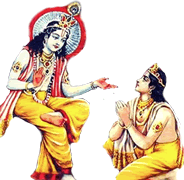 Uddhava Gîtâ (e-book pdf): Next to the Bhagavad Gîtâ
there is a second talk of Krishna in which He extensively reports about
His science and nature. The second time He spoke His mind to His
nephew, great friend and devotee Uddhava, just before Krishna left the earth. This Gîtâ, part of the masterly frame story the Bhâgavata Purâna - the so-called S'rîmad
Bhâgavatam - is of a different tone. While He in the
Bhagavad Gîtâ admonishes Arjuna to fight and perform
his duty as a warrior, Krishna in this talk advises Uddhava on how to
serve Him with devotion and find liberation when He Himself is no
longer physically present on earth. The story
has a more personal ring, is more narrative with examples and dilates a
bit more, even though sometimes the same or likewise verses are
encountered. The story is therefore easier to read and less abstract.
Uddhava Gîtâ (e-book pdf): Next to the Bhagavad Gîtâ
there is a second talk of Krishna in which He extensively reports about
His science and nature. The second time He spoke His mind to His
nephew, great friend and devotee Uddhava, just before Krishna left the earth. This Gîtâ, part of the masterly frame story the Bhâgavata Purâna - the so-called S'rîmad
Bhâgavatam - is of a different tone. While He in the
Bhagavad Gîtâ admonishes Arjuna to fight and perform
his duty as a warrior, Krishna in this talk advises Uddhava on how to
serve Him with devotion and find liberation when He Himself is no
longer physically present on earth. The story
has a more personal ring, is more narrative with examples and dilates a
bit more, even though sometimes the same or likewise verses are
encountered. The story is therefore easier to read and less abstract.
 In the year 2000 was
started with the concatenation of the, already translated, story of
Krishna, the S'rîmad
Bhâgavatam (the Bhâgavata Purâna) on the Internet
(18000 verses in twelve sections called Canto's). This book contains
the essence of the vedic knowledge and tells the complete story of the
life and times, the appearance and disappearance of Lord Krishna, the
Lord of Yoga and his other appearances and expansions. For that reason
it received the subtitle ''The Story of the Fortunate One'. The book
could be called the authentic 'Krishna-bible'. In this version of the
story the effort has been made at the one hand to make it a readable
but verse to verse and word to word faithful story in the form of a
running narrative, while at the other hand the original translations of
the preceding version and the Sanskrit have been added, so that anyone
can see what has been done with the text. There is a separate pdf for
the tenth Canto, the life of Sri Krishna tited The Summum Bonum.
In the year 2000 was
started with the concatenation of the, already translated, story of
Krishna, the S'rîmad
Bhâgavatam (the Bhâgavata Purâna) on the Internet
(18000 verses in twelve sections called Canto's). This book contains
the essence of the vedic knowledge and tells the complete story of the
life and times, the appearance and disappearance of Lord Krishna, the
Lord of Yoga and his other appearances and expansions. For that reason
it received the subtitle ''The Story of the Fortunate One'. The book
could be called the authentic 'Krishna-bible'. In this version of the
story the effort has been made at the one hand to make it a readable
but verse to verse and word to word faithful story in the form of a
running narrative, while at the other hand the original translations of
the preceding version and the Sanskrit have been added, so that anyone
can see what has been done with the text. There is a separate pdf for
the tenth Canto, the life of Sri Krishna tited The Summum Bonum.
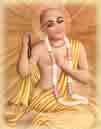 As yet only in Dutch there
is a study to the culture of devotion, the philosopy and the music of
Vaishnavism, the tradition of the Vishnu-monks who took the Bhiagavatam
to the West. It is a book of about 400 pages presenting a comment on
the first four chapters of the Bhagavad Gita. Not speaking Dutch it can
be appreciated for its pictures and music-files of the songs of the
âcâryas. The English versions of these songs can be found
at the music page of srimadbhagavatam.org. For the Gîtâ
in question, see above. The book is called: Krishna en de Zingende Filosoof (Krishna
and the Singing Philosopher).
As yet only in Dutch there
is a study to the culture of devotion, the philosopy and the music of
Vaishnavism, the tradition of the Vishnu-monks who took the Bhiagavatam
to the West. It is a book of about 400 pages presenting a comment on
the first four chapters of the Bhagavad Gita. Not speaking Dutch it can
be appreciated for its pictures and music-files of the songs of the
âcâryas. The English versions of these songs can be found
at the music page of srimadbhagavatam.org. For the Gîtâ
in question, see above. The book is called: Krishna en de Zingende Filosoof (Krishna
and the Singing Philosopher).
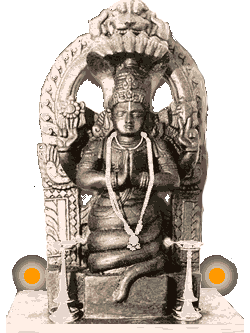 The Yogasûtras of Patañjali are a classical concept. They constitute
the backbone of the discipline of yoga: the science of uniting one's
consciousness. There are many interpretations though of this analytical
masterpiece of the incarnation of Âdi-S'esha who is
Patañjali. Patanjali is the first expansion of the ego of Vishnu
in hindu mythology. This condensed work, this summary so to say, about
the discipline of connecting oneself with the soul, thus forms the ego
of yoga, The different existing interpretations all together plead for
this text the same way as the music of J. S. Bach is so excellent
because it cannot be spoilt by interpretation. This
literary-philosophical monument from the indian realm is here
represented from the perspective of this site: the time, the ether, and
gross matter are all equally fundamental expressions of the divine of
nature and thus is the yoga actually the most concrete of all sciences
around. For it relates directly to these fundamental absolute truths
when it offers us the discipline to live with them. The yoga turning
away from time, space and matter does, meditating on it, land right in
the middle of it as the one and only correct vision upon it, as the
only right consciousness of unifying therewith, ... of the natural
order of the consciousness of time therewith.
The Yogasûtras of Patañjali are a classical concept. They constitute
the backbone of the discipline of yoga: the science of uniting one's
consciousness. There are many interpretations though of this analytical
masterpiece of the incarnation of Âdi-S'esha who is
Patañjali. Patanjali is the first expansion of the ego of Vishnu
in hindu mythology. This condensed work, this summary so to say, about
the discipline of connecting oneself with the soul, thus forms the ego
of yoga, The different existing interpretations all together plead for
this text the same way as the music of J. S. Bach is so excellent
because it cannot be spoilt by interpretation. This
literary-philosophical monument from the indian realm is here
represented from the perspective of this site: the time, the ether, and
gross matter are all equally fundamental expressions of the divine of
nature and thus is the yoga actually the most concrete of all sciences
around. For it relates directly to these fundamental absolute truths
when it offers us the discipline to live with them. The yoga turning
away from time, space and matter does, meditating on it, land right in
the middle of it as the one and only correct vision upon it, as the
only right consciousness of unifying therewith, ... of the natural
order of the consciousness of time therewith.
Click
here to visit the Homepage of Anand
Aadhar, the translator.
He offers also other writings on spirituality and the unification of
consciousness from the point of view of the filognosy at this site and
his Aadhar Yoga: the yoga of the foundation of happiness.
* About the pictures: The
first picture above concerns Draupadî, standing for the purity of
the vedic religion, who as the wife of the Pândavas is undressed
in public by their malignant nephews as a prelude to the war of
Kurukshetra where the ancient glory of the vedic culture came to a stop
and the 'Kali ' or iron' age of chronic political discord began.
Krishna from the beyond provides new cloth to preclude her
embarrasment. The second picture is called 'Religion helped by Spain' (by Tiziano), where also a naked religion is pictured
embarrassed about the new times of heretical modernity, this time
helped by the state of Spain also offering a fabric for understanding.